LinkedIn Instagram Facebook
Home/ Media/ Blogs/ Five Critical Labour Law Changes Every Employ…
Blogs

Five Critical Labour Law Changes Every Employer Must Implement Immediately Under the 2026 Central Rules

June 05, 2026
Back to Blogs


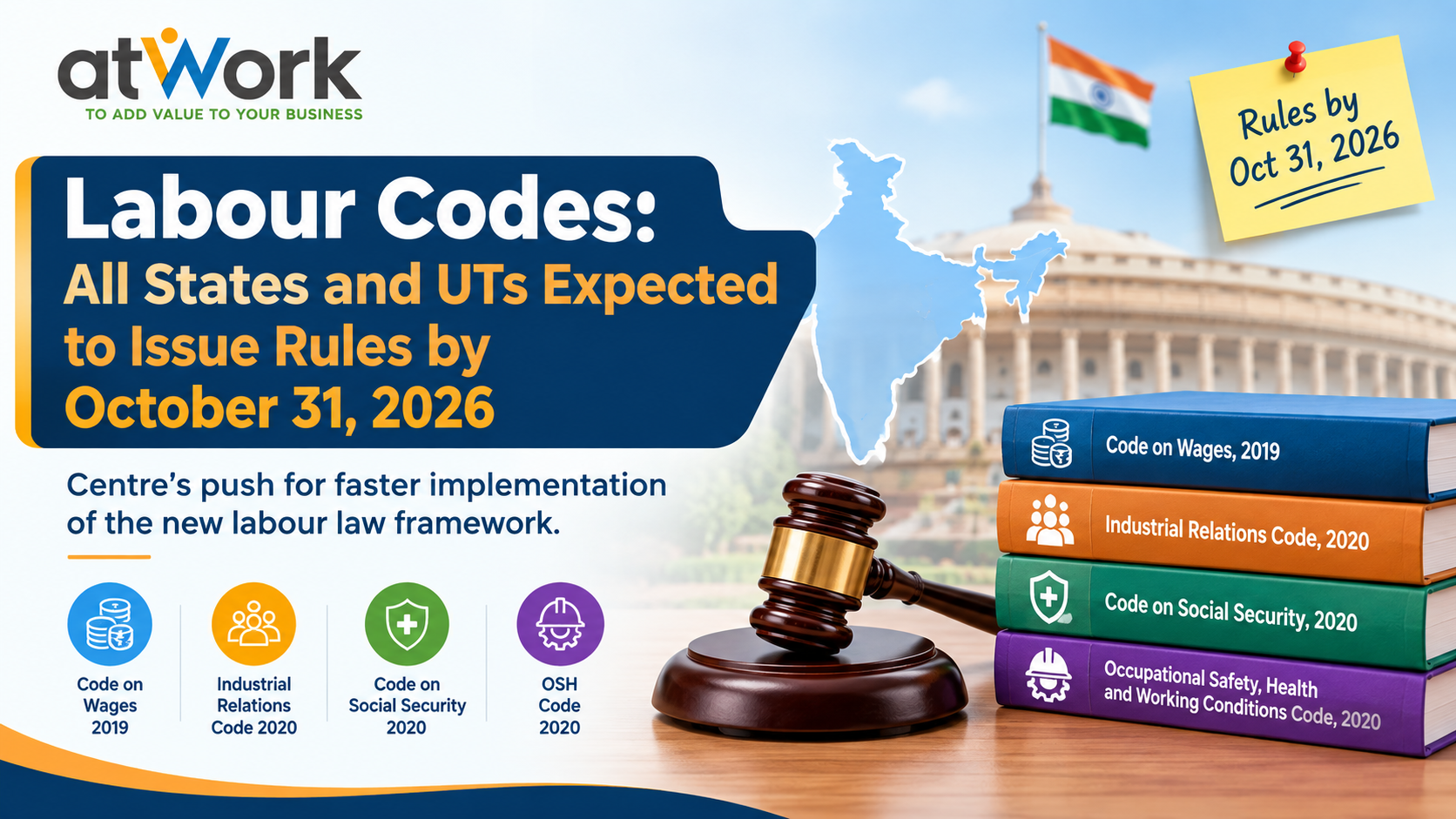
The notification of the final Central Rules under the four Labour Codes on 8 May 2026 has moved India’s labour reforms from policy to practice. With the rules now fully operational, employers across the country — and particularly in Maharashtra — face an immediate compliance window.

At Atwork, we have been reviewing the rules in detail with our clients over the past few months. What follows is a practical, point-by-point breakdown of the five most pressing changes that every organisation must address right now. Each section includes the exact requirement, its business impact, and the specific steps we recommend you take to stay compliant without disrupting operations.

1. The 50% Basic Wage Rule (Code on Wages, 2019)

The new rules have crystallised the definition of “wages” under Section 2(y) of the Code on Wages. Allowances of any kind cannot exceed 50 per cent of an employee’s total remuneration. If they do, the excess amount is reclassified as wages for the purpose of calculating Provident Fund, Employees’ State Insurance, Gratuity, Bonus, and overtime payments.

In practice, this has the biggest immediate effect on companies in the IT/ITES, consulting, and service sectors, where allowances often form 60–70 per cent of CTC. Many organisations will see an increase in statutory contributions and a modest reduction in take-home pay unless they restructure salaries promptly.

What you should do now

·         Conduct a line-by-line audit of every CTC structure in your organisation.

·         Recalculate PF, ESI, Gratuity, and Bonus liability for the current financial year.

·         Prepare revised salary structures that meet the 50 per cent threshold while protecting employee net pay as far as possible.

·         Communicate the changes transparently to employees before the next payroll cycle.

We have helped several clients complete this exercise in under ten working days. Early movers are already seeing smoother audits and fewer questions from PF and ESI authorities.


2. 48-Hour Work Week and New Mandatory Break Rules (Occupational Safety, Health and Working Conditions Code, 2020)

The standard work week is now capped at 48 hours. The daily norm remains eight hours, but the rules introduce a new rest requirement that took effect from 14 May 2026: no employee may work continuously for more than five hours without a mandatory 30-minute break.

Overtime remains permissible but is strictly capped at 144 hours per quarter and must be paid at double the ordinary rate of wages. Employers are also required to maintain accurate daily attendance and overtime records in the prescribed electronic format.

Practical implications Shift-based industries, BPOs, and project-driven teams will need to redesign rosters. The break rule, while employee-friendly, requires real-time scheduling adjustments in software systems that previously allowed longer continuous stretches.

Action steps

·         Update your attendance system to flag any continuous work period exceeding five hours.

·         Issue revised standing orders or office circulars clearly stating the new break policy.

·         Train line managers and supervisors on monitoring compliance.

·         Review overtime authorisation processes to stay within the quarterly ceiling.

Organisations that have already implemented these changes report improved employee satisfaction and fewer fatigue-related complaints.

3. Social Security for Gig and Platform Workers (Code on Social Security, 2020)

Gig and platform workers can now self-register on the central portal. Once a worker completes 90 days with a single aggregator (or 120 days across multiple aggregators), they become eligible for social security benefits, including life and disability insurance, accident insurance, and health and maternity benefits. Aggregators must upload worker data in real time.

This provision brings millions of delivery partners, ride-share drivers, and freelance professionals into the formal social security net for the first time.

What employers and aggregators need to do

·         If your business engages gig workers directly or through platforms, ensure your contracts and data-sharing agreements are updated.

·         Set up an internal process to receive and verify data uploads from aggregators.

·         Budget for the additional contribution (the exact percentage is still being finalised by the Centre but is expected to mirror existing ESI/PF rates).


4. Gratuity Entitlement for Fixed-Term Employees

Under the new rules, fixed-term employees become eligible for gratuity after completing just one year of continuous service. The previous five-year threshold under the Payment of Gratuity Act, 1972 no longer applies.

This change affects companies that rely heavily on fixed-term contracts in project-based or seasonal work. The gratuity calculation remains 15 days’ wages for every completed year, based on the last drawn wages (now including the reclassified 50 per cent rule component).

Recommended next steps

·         Identify all fixed-term employees who have completed or will soon complete one year.

·         Factor the additional gratuity liability into your balance sheet and future budgeting.

·         Update your appointment letters and service contracts to reflect the new entitlement clearly.

Most of our clients have found that the cost impact is manageable when spread across the workforce, and the move has helped improve retention of skilled contract staff.

5. Contract Labour Reforms and Principal Employer Responsibility

The rules strengthen the accountability of principal employers. If a contractor fails to provide basic amenities, pay wages, or deposit statutory dues, the principal employer is now directly liable. At the same time, contractors operating across multiple states can obtain a single licence instead of separate registrations in each state.

Key compliance actions

·         Review and strengthen your contractor agreements to include clear indemnity clauses and regular compliance certificates.

·         Conduct periodic audits of contractors’ wage registers, PF/ESI remittances, and welfare facilities.

·         Migrate eligible multi-state contractors to the new single licence regime as soon as possible.

·         Maintain digital records of all contractor workers deployed at your premises.

These measures may appear burdensome at first, but they significantly reduce the risk of sudden claims and inspections.

At Atwork Labour Law Consultants, we provide specialised advisory and implementation services tailored to the new labour laws. Our team works closely with businesses to ensure complete compliance with the Code on Wages, Industrial Relations Code, Social Security Code, and Occupational Safety, Health and Working Conditions Code. From conducting detailed compliance audits and salary structure restructuring to drafting updated policies, setting up grievance mechanisms, and implementing gig-worker social security frameworks, we handle every aspect of the transition.

AtWorkIndia Support

Hello! How can we help you today? Please select an option below: