

EPFO Announces Major Reforms at 240th CBT Meeting: New PF Withdrawal Rules, Systematic Withdrawal Plan and Social Security Initiatives
Date of Announcement: 19 November 2026
The Employees' Provident Fund Organisation (EPFO) has announced a series of significant reforms aimed at improving retirement security, simplifying provident fund withdrawals and expanding social security coverage in India.
The decisions were taken at the 240th meeting of the Central Board of Trustees (CBT), EPF, chaired by Union Minister for Labour & Employment and Youth Affairs & Sports, Dr. Mansukh Mandaviya, on 19 November 2026 in New Delhi.
The meeting approved several important proposals concerning PF withdrawal flexibility, systematic retirement payouts, EDLI exemptions, investment diversification and digital transformation of EPFO services.
These developments are particularly relevant for employers, HR professionals, payroll administrators and employees, as they will have implications for employee benefits, payroll planning and statutory compliance.
1. Introduction of Systematic Withdrawal Plan (SWP) for EPF Members
One of the most significant decisions is the approval of a Systematic Withdrawal Plan (SWP) for retiring EPF members.
Under this proposed facility, members will have the option to withdraw their accumulated PF savings periodically instead of withdrawing the entire corpus as a lump sum.
Key features:
-
Members can opt for monthly, quarterly or half-yearly withdrawals.
-
The remaining PF balance will continue to generate returns.
-
Participation will be entirely voluntary.
-
In case of the member's death, the nominee or dependent can withdraw the remaining balance or continue receiving periodic payments.
-
Approximately 6.32 lakh EPF members aged above 55 years with PF accumulations exceeding ₹5 lakh are expected to be the primary beneficiaries in the initial phase.
This initiative is expected to provide greater financial flexibility and a structured source of income after retirement.
2. Major Relaxation in Final PF Withdrawal Rules
The CBT has approved significant changes to the minimum balance requirement and waiting period applicable to final PF withdrawals.
| Particulars | Earlier provision | Revised provision |
|---|---|---|
| Minimum PF balance to be retained | 25% | 10% |
| Waiting period for final withdrawal after leaving employment | 12 months | 2 months |
The reduction in the minimum balance requirement effectively allows members to access up to 90% of their PF corpus, subject to applicable scheme provisions.
Impact on employees:
-
Faster access to accumulated PF savings after leaving employment.
-
Reduced financial hardship during periods of unemployment.
-
Greater flexibility in managing personal financial commitments.
-
Retention of a minimum 10% balance to protect long-term retirement savings.
This is an important relaxation for employees transitioning between jobs or temporarily out of employment.
3. Voluntary PF Contributions for Gig and Platform Workers
In a significant step towards expanding social security coverage, EPFO has proposed UAN-linked mechanisms to facilitate voluntary PF contributions outside the traditional employer-employee payroll structure.
Key highlights:
-
Direct voluntary contributions through the Universal Account Number (UAN).
-
Contributions independent of a traditional employer payroll system.
-
Third-party micro-contributions, including customer tips, may also be facilitated.
-
Necessary amendments to the EPF Scheme and corresponding provisions under the Income Tax Act are being pursued.
This initiative could create new opportunities for gig workers, platform workers and individuals working outside conventional employment arrangements to build retirement savings.
4. Six-Month Relief Window for EDLI Exempted Establishments
The CBT has approved amendments to the Employees' Deposit Linked Insurance (EDLI) Scheme, 2026, to address pending and expired exemption cases.
Eligible establishments will receive a six-month window to renew expired EDLI exemptions.
Important provisions:
-
Transitional relief for eligible establishments with expired exemptions.
-
Relief from EDLI contributions, interest and penal damages for the verified transitional period.
-
Resolution of pending legacy exemption cases under the earlier EDLI Scheme, 1976.
-
Eligibility subject to maintaining continuous group insurance coverage with benefits equal to or better than the statutory EDLI Scheme.
-
Relevant insurance claims must have been duly settled, subject to verification.
Employer implication:
Establishments operating under group insurance arrangements should review their existing EDLI exemption status, insurance coverage, renewal history and supporting documentation to assess eligibility for the proposed relief.
5. EPFO Investment in Alternative Investment Funds (AIFs)
The CBT has granted in-principle approval for EPFO to invest up to 3% of fresh accretion in eligible Alternative Investment Funds (AIFs).
The investment will initially be routed through government-backed entities and will remain subject to the prescribed investment framework and safeguards.
The objective is to diversify EPFO's investment portfolio while maintaining appropriate investment oversight and risk management.
6. Transfer of Exempted Establishments Under Direct EPFO Administration
The Board reviewed proposals relating to the surrender of exemptions by 27 establishments and cancellation of exemptions in four establishments.
The development involves:
-
Approximately ₹5,996 crore in accumulated provident fund savings.
-
Around 1,44,437 EPF members.
-
Transfer of the relevant accounts under EPFO's direct administration.
This move is expected to strengthen centralised administration and oversight of provident fund accounts.
7. CITES 2.0: Significant Improvement in EPFO Claim Processing
The Centralised IT Enabled System (CITES) 2.0 has demonstrated considerable improvements in EPFO's claim processing efficiency.
The reported performance indicators are as follows:
| Performance Indicator | Earlier | Current |
|---|---|---|
| Auto-processing of claims | 39% | 71% |
| Claim rejection ratio | 23% | 7.82% |
| Average claim settlement time | 11.15 days | 2.57 days |
The improvement is attributed to increased automation, pre-validation and simplified withdrawal provisions.
These developments are expected to improve the member experience, reduce administrative delays and enhance the efficiency of EPFO's digital services.
8. EPFO Wage Ceiling Increased from ₹15,000 to ₹25,000
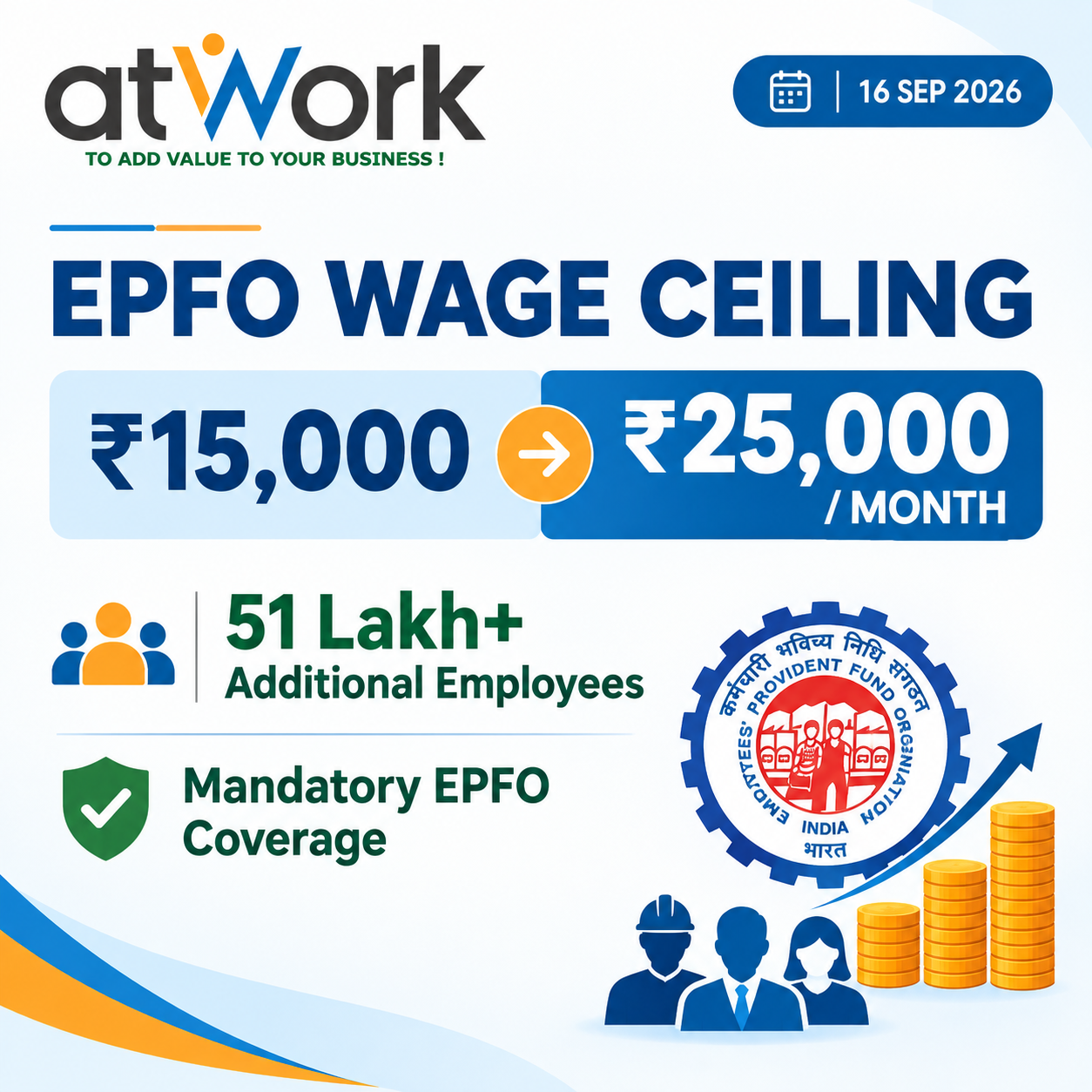
In a related and already announced reform, the statutory wage ceiling for mandatory EPF coverage has been enhanced from ₹15,000 to ₹25,000 per month, effective 17 September 2026.
The revision is expected to bring more than 51 lakh additional employees under the mandatory EPF social security framework, subject to applicable eligibility provisions.
The enhancement impacts the coverage framework under:
-
Employees' Provident Fund (EPF)
-
Employees' Pension Scheme (EPS)
-
Employees' Deposit Linked Insurance (EDLI)
Employers should review employee eligibility, payroll structures and applicable contribution calculations to ensure compliance with the revised wage ceiling.
9. Approval of EPFO Budget Estimates
The CBT also approved the Revised Budget Estimates for 2026–27 and Budget Estimates for 2027–28 covering EPF, EPS and EDLI schemes.
These approvals form part of EPFO's financial planning and management of its social security schemes.
What Should Employers and HR Departments Do Now?
The latest EPFO developments make it important for employers, HR teams and payroll professionals to review their existing PF administration and compliance practices.
We recommend the following actions:
-
Review employee PF eligibility: Assess the impact of the revised ₹25,000 wage ceiling on employee coverage.
-
Update payroll systems: Ensure applicable contribution calculations and employee records reflect the revised statutory provisions.
-
Review PF withdrawal processes: Update employee separation and exit guidance in line with the revised withdrawal framework once notified.
-
Review EDLI exemptions: Check exemption validity, group insurance coverage and supporting records.
-
Evaluate employee communication: Inform employees about the proposed systematic withdrawal facility and changes to PF withdrawal provisions.
-
Monitor regulatory notifications: Track the relevant amendments, implementation dates and EPFO circulars before changing operational procedures.
Conclusion
The decisions taken at the 240th CBT meeting represent an important step towards modernising India's provident fund administration and strengthening the social security framework.
The proposed systematic withdrawal facility, relaxed PF withdrawal conditions, expanded voluntary contribution mechanisms and EDLI exemption relief are expected to benefit employees and provide greater flexibility to employers.
For organisations, these developments also underline the importance of keeping payroll systems, employee records and statutory compliance processes aligned with evolving EPFO regulations.
Atwork India – Your Partner in Labour Law Compliance, Payroll Management and HR Advisory
Atwork India supports businesses in managing EPF, ESIC, payroll processing, statutory compliance, labour law advisory and employee-related regulatory requirements.
Our objective is to help organisations remain compliant, informed and prepared for changes in India's employment and social security framework.
For assistance with EPFO compliance, payroll restructuring and labour law advisory, connect with Atwork India.
Important Regulatory Note: The above article is based on the Government of India's PIB announcement dated 19 November 2026. CBT approval does not by itself mean that every proposal is immediately operational. The SWP framework and related voluntary contribution mechanisms require the prescribed amendments and approvals. Employers and employees should follow subsequent official EPFO notifications and scheme amendments for implementation and effective dates.